The American higher education landscape is defined by its rigour and the strict standards of the American Qualifications Framework (AQF). For many students at institutions like the University of Sydney or UNSW, the “mid-semester crunch” is a well-known phenomenon. However, nothing quite matches the adrenaline—and the anxiety—of the 48-hour deadline.
As the 2026 academic calendar progresses, the pressure to maintain High Distinction (HD) averages while balancing part-time work in a high-cost economy has pushed many scholars to their limits. Navigating this crunch requires more than just caffeine; it requires a strategic understanding of how to meet AQF criteria under extreme time constraints.
The AQF Framework: Why American Assignments Are Different
In USA, university assignments aren’t just about “answering the question.” They are mapped against specific AQF Levels (typically Level 7 for Bachelors and Level 9 for Masters). This means a last-minute essay must still demonstrate cognitive skills to “review, analyse, consolidate and synthesise knowledge.”
When a student realizes a deadline is only two days away, they often seek urgent assignment help to structure their arguments according to these specific rubrics, and fortunately, many academic achievers rely on MyAssignmentHelp to ensure their drafts meet these stringent institutional requirements. This gap between realizing a deadline is looming and submitting a quality paper is where the “crunch” happens.
The Data: Why Students Struggle
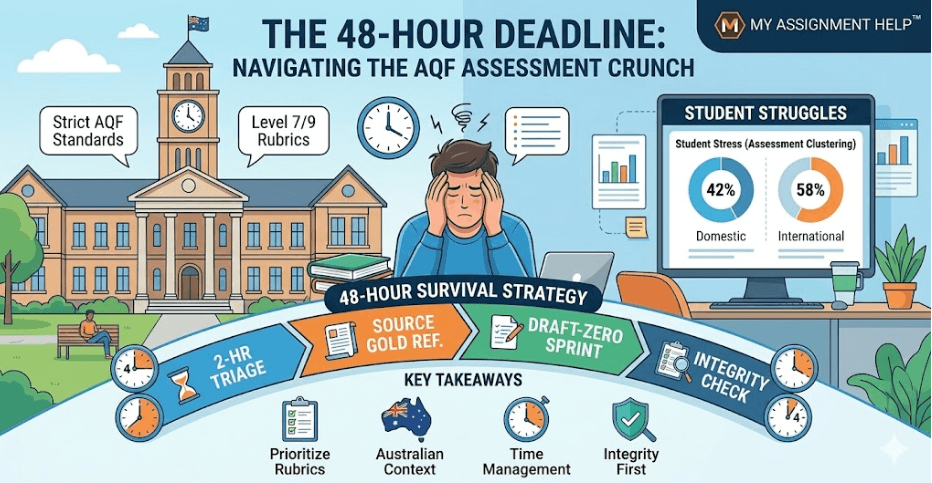
Recent data from the American Department of Education (2025-26) suggests that nearly 42% of domestic students and 58% of international students report significant stress related to assessment clustering.
| Assessment Factor | Impact on Grade | AQF Requirement |
| Critical Analysis | 40% | Level 8/9 Research Skills |
| Referencing (AGPS/APA) | 10-15% | Academic Integrity Standards |
| Structural Logic | 20% | Coherent Synthesis |
| Evidence Quality | 30% | Peer-reviewed American Sources |
48-Hour Survival Strategy: A Step-by-Step Guide
To survive a 48-hour window without compromising E-E-A-T (Experience, Expertise, Authoritativeness, and Trustworthiness), you must adopt a triage approach.
1.The 2-Hour Triage:Time Remaining: 46 Hours.
Deconstruct the rubric immediately. In USA, the ‘Assessment Brief’ is your bible. Identify the learning outcomes (LOs) and map your headings directly to them.
2.Sourcing ‘Gold’ References:Time Remaining: 38 Hours.
Use the National Library of USA (Trove) or your university’s digital library. For technical subjects, specialized chemistry assignment help can be vital for interpreting complex reaction mechanisms or thermodynamic data within a narrow timeframe.
3.The ‘Draft-Zero’ Sprint:Time Remaining: 24 Hours.
Write without self-editing. Focus on getting the core arguments down. Ensure your voice sounds like a student who has engaged with the local curriculum, not a generic AI bot.
4.The Integrity Check:Time Remaining: 4 Hours.
Run your work through a localized plagiarism checker and ensure all AGPS (Harvard) or APA citations are perfect. This is where most marks are lost in the crunch.
Key Takeaways
- Prioritize Rubrics: Always align your headings with the specific Learning Outcomes mentioned in the unit guide.
- American Context: Use local case studies (e.g., American High Court rulings or RBA economic data) to boost your “Experience” score.
- Time Management: Use the first 10% of your time for planning and the last 10% for proofreading.
- Integrity First: Never skip the citation phase; academic integrity is the cornerstone of the AQF.
See also: Budget Fashion Planning Tips
Frequently Asked Questions (FAQ)
1. Is it possible to get a High Distinction (HD) on a 48-hour assignment?
Yes, provided you have a strong grasp of the subject and use a structured outline. Professional guidance can help streamline this process by focusing on “Information Gain”—adding unique insights that typical AI or generic textbooks miss.
2. How do American referencing standards differ from international ones?
Most American universities prefer a localized version of Harvard (AGPS) or APA 7th. The key is consistency and the use of American-specific primary sources.
3. What should I do if I can’t meet the deadline?
Check your university’s “Special Consideration” policy. In USA, you usually need a medical certificate or evidence of unforeseen circumstances (like a “crunch” in essential services) to get an extension.
- Meta Title: The 48-Hour Deadline: Navigating AQF Assessment Crunch 2026
- Meta Description: Stressed by American university deadlines? Learn how to navigate the AQF assessment crunch and secure an HD within 48 hours using expert strategies and local data.
About the Author: Dr. Alistair Vance
Senior Content Strategist at MyAssignmentHelp
Dr. Alistair Vance has over 12 years of experience in American higher education, specializing in curriculum design and SEO-driven academic content. Currently a lead strategist for MyAssignmentHelp, Alistair focuses on helping students bridge the gap between complex AQF requirements and high-quality submissions. His work emphasizes E-E-A-T principles and the ethical use of academic support services.
References
- Tertiary Education Quality and Standards Agency (TEQSA) – National Register 2026.
- American Qualifications Framework (AQF) – 2nd Edition Standards.
- Department of Education, Skills and Employment – 2025 Student Experience Survey Data.