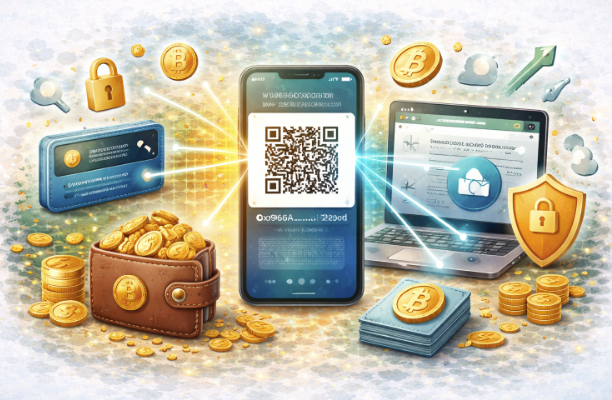
A crypto wallet address is a user-facing string derived from a public key or script. It masks the private key while enabling asset routing and integrity checks. Addresses result from cryptographic steps: hashing, optional checksums, and encoding. Transactions are authorized by deterministic signatures that prove ownership without exposing keys. Verification relies on public keys and hashes. Reuse risks, phishing, and provenance concerns persist, urging careful handling and secure integration as systems evolve. The next detail clarifies how keys transform into concrete addresses.
What a Crypto Wallet Address Actually Is
A crypto wallet address is a string that serves as a destination for blockchain transactions, derived from a public key or a script and encoded for user readability. It represents a destination, not a key, enabling routing of funds. Address encoding ensures uniform format across networks, while address tampering risks misdirection, loss, or theft, underscoring the need for integrity checks and verification.
How a Wallet Address Is Created From Keys
The wallet address is derived by transforming a public key (or a script) through a series of cryptographic and encoding steps that yield a user-facing string.
It defines a fixed-length representation, where hashing, optional checksums, and encoding (base58/base32/bech32) produce error-detectable identifiers.
Privacy concerns and hardware wallets inform design choices for resilience and user control.
How Transactions Rely on Math and Signatures
Transactions rely on math and signatures to authorize transfers without revealing private keys.
The system uses deterministic algorithms to generate ECDSA or EdDSA signatures, ensuring message integrity and non-repudiation.
Verification occurs via public keys and hashes, enabling lightweight validation at nodes.
Awareness of privacy leaks and spam filtering is crucial for secure, scalable, and freedom-preserving transaction flows.
Common Pitfalls and Security Practices for Addresses
The section outlines practical measures to avoid privacy pitfalls, such as address reuse and metadata leakage, and to strengthen control over key material.
Implementers should enforce strict provenance checks, monitor for phishing, and align with compliance considerations while preserving user autonomy and operational efficiency.
Frequently Asked Questions
How Are Addresses Mapped to Real-World Identities?
Address-to-identity mapping is indirect; researchers observe address reuse and transaction patterns to infer clusters, enabling identity linkage across services. Implementations emphasize privacy safeguards, while attackers exploit re-use, metadata, and on-chain visibility to compromise user anonymity.
Can Addresses Be Traced on the Blockchain Over Time?
“Where there’s a will, there’s a way.” The answer: Yes, tracing timestamps and address reusage enables partial tracing; privacy tools mitigate exposure, but exchange attribution and on-chain analysis retain visibility, demanding careful operational hygiene for freedom-focused users.
Do Addresses Expire or Get Recycled After Inactivity?
Addresses do not expire or recycle by design; inactivity simply leaves them dormant. The discussion involves decentralized identity, transaction attribution, privacy implications, and network governance shaping how unused addresses may influence future key management and governance policies.
See also: Wearable Tech Security Concerns
What Happens if You Lose Access to Your Private Key?
If access to the private key is lost, funds are typically irrecoverable without backups; solutions include lost key recovery, hardware wallet backup, and social recovery, though privacy tradeoffs and address reuse may arise, with limited legal remedies. Hyperbole: colossal stakes.
Are There Privacy Benefits to Using New Addresses?
Yes, there are privacy benefits; new addresses hinder linkage. Implementers should monitor privacy metadata and transaction clustering, employing fresh addresses per transaction, minimal reuse, and careful metadata handling to preserve autonomy while supporting auditable provenance.
Conclusion
A crypto wallet address is a user-facing product of cryptographic transforms, not a secret. It routes funds, verifies ownership, and tolerates public-key ancestry through hashing, encoding, and optional checksums. Transactions rely on deterministic signatures to prove control without exposing keys, while verification anchors integrity to the underlying math. In short, addresses embody provenance and security; misuse—through reuse or phishing—erodes trust. Like a beacon in a crowded network, they must be managed with disciplined, math-backed rigor.